


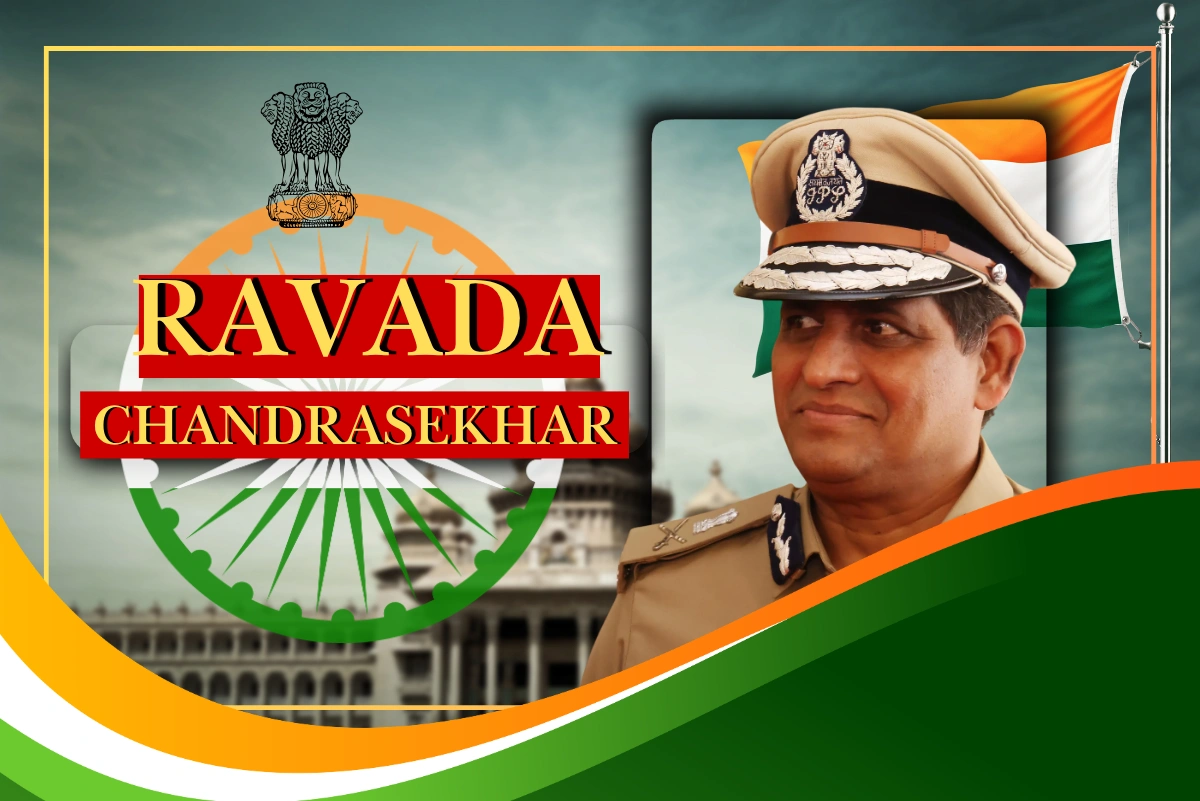
A boy grows up in the lush riverside heartland of West Godavari in Andhra Pradesh, son of a humble farmer named Ravada Venkita Rao, and decades later finds himself at the very top of one of India’s most complex and politically charged state police forces. Sounds like the plot of a Telugu action film, right? Well, this is real life — and this is the story of Ravada Chandrasekhar.
- Quick Stats: Ravada Chandrasekhar at a Glance
- From Godavari to God’s Own Country: The Early Life of Ravada Chandrasekhar
- The Career That Reads Like a Malayalam Thriller
- The Koothuparamba Controversy: The Scar That Never Quite Healed
- The Big Appointment: Becoming Kerala’s 41st DGP
- The Supreme Court Connection: Why 2 Years Matter
- What Defines Ravada Chandrasekhar’s Leadership Style?
- Kerala Police: The Institution He Now Leads
- Ravada Chandrasekhar and the 2026 Kerala Assembly Elections
- The Road Less Travelled: Central Deputation at the IB
- The Bigger Picture: What Ravada Chandrasekhar Represents
- Conclusion: A Career That Commands Attention
- Frequently Asked Questions
- Q1. Who is Ravada Chandrasekhar?
- Q2. Where is Ravada Chandrasekhar from?
- Q3. What is the Koothuparamba firing incident?
- Q4. How did Ravada Chandrasekhar become DGP of Kerala?
- Q5. What is Ravada Chandrasekhar’s main focus as DGP?
- Q6. How long will Ravada Chandrasekhar serve as DGP?
- Q7. What was Ravada Chandrasekhar’s role at the Intelligence Bureau?
- Q8. Which districts did Ravada Chandrasekhar serve in as SP?
Ravada Azad Chandrasekhar is a 1991-batch Indian Police Service (IPS) officer who currently serves as the State Police Chief of Kerala. He didn’t just walk into this role — he earned it, survived a firestorm of controversy, navigated the labyrinth of Indian bureaucracy, and came out on the other side as the 41st Director General of Police (DGP) of Kerala. No dramatic background score needed. The man’s career IS the background score.
Quick Stats: Ravada Chandrasekhar at a Glance
| Category | Details |
|---|---|
| Full Name | Ravada Azad Chandrasekhar |
| Date of Birth | 5 July 1966 |
| Birthplace | West Godavari, Andhra Pradesh, India |
| Father | Ravada Venkita Rao (Farmer) |
| Religion | Hinduism |
| Nationality | Indian |
| IPS Batch | 1991 |
| Cadre | Kerala (Indian Police Service) |
| Current Position | Director General of Police (DGP) & State Police Chief, Kerala |
| Assumed Office | 1 July 2025 |
| Previous Role | Special Director, Intelligence Bureau (IB) |
| Preceded by | Sheikh Darvesh Saheb |
| Marital Status | Married |
| Approximate Salary | ₹2,25,000 per month |
| Eye Colour | Grey |
| Hair Colour | Black |
From Godavari to God’s Own Country: The Early Life of Ravada Chandrasekhar
Every great story has humble origins, and Ravada Chandrasekhar’s is no exception. Born on 5 July 1966 in West Godavari district of Andhra Pradesh, he was raised in a family deeply rooted in agrarian life. His father, Ravada Venkita Rao, was a farmer — the kind of man who knew the value of hard work before sunrise.
Growing up in the fertile Godavari belt, young Chandrasekhar would have seen the rhythms of rural India up close: the monsoon-dependent lives, the community struggles, and the quiet dignity of people who work the land. It’s the kind of upbringing that doesn’t just build character — it is character.
He went on to crack one of India’s most gruelling examinations — the UPSC Civil Services — and was allocated to the IPS in the 1991 batch with Kerala cadre. Moving from the sun-baked plains of Andhra Pradesh to the coconut-lined backwaters of Kerala was more than just a geographical shift. It was the beginning of a career that would test him in ways no examination ever could.
Expert Insight: “Officers who come from agrarian or modest backgrounds often bring a grounded sense of justice to their policing,” says former IPS trainer and governance expert Dr. Meenakshi Arora. “They understand community dynamics from lived experience, not just textbooks.”
The Career That Reads Like a Malayalam Thriller
Early Postings: A Career Built District by District
Ravada Chandrasekhar didn’t start at the top — he built his career one district at a time. He began his policing career in Kerala with his first posting as Assistant Superintendent of Police (ASP) in Thalassery. Over the years, he served as Superintendent of Police in Wayanad, Malappuram, Ernakulam Rural, and Palakkad districts.
That’s four of Kerala’s most demanding districts — each with its own political sensitivities, law and order challenges, and topographic complexities. Wayanad’s tribal belt, Malappuram’s dense population, Ernakulam’s urban crime landscape, Palakkad’s border dynamics — if policing in Kerala were a video game, Chandrasekhar played it on Expert Mode.
He later served as the DIG of Thrissur and Kochi — two of the state’s most economically and culturally significant cities. He also held the position of Commissioner of Police in Thiruvananthapuram, the state capital. That’s essentially the whole of Kerala covered in one career resume. Impressive doesn’t begin to cover it.
The Intelligence Bureau Chapter
Before his appointment as DGP, Ravada Chandrasekhar was serving on central deputation as Special Director in the Intelligence Bureau (IB). He was among the three names accepted by the UPSC for the DGP post in Kerala. This is no small thing — the Intelligence Bureau is India’s domestic intelligence agency, and serving as a Special Director there means you’re at the intersection of national security and state-level law enforcement. It’s the kind of role that requires discretion, strategic thinking, and the ability to connect dots that nobody else can see.
The Koothuparamba Controversy: The Scar That Never Quite Healed
Let’s talk about the elephant in the room — or more accurately, the ghost in Kannur.
No biography of Ravada Chandrasekhar is complete without addressing the 1994 Koothuparamba firing incident. It is perhaps the most defining chapter of his early career, and it nearly derailed everything.
On 25 November 1994, two days after being moved from Hyderabad, Chandrasekhar was posted as Assistant Superintendent of Police (ASP) in Kerala. Soon after taking charge, he led a police operation that turned into one of the worst cases of political violence in Kerala’s history.
Here’s what happened:
In the aftermath of the Koothuparamba firing incident on November 25, 1994 — when police opened fire on a crowd, resulting in the deaths of five DYFI activists (K.K. Rajeevan, Madhu, Shibulal, Babu, and Roshan) and injuries to six others — Chandrasekhar faced legal proceedings.
The context? Thousands of DYFI (Democratic Youth Federation of India) activists had gathered along the Thalassery Road in Kannur, blocking the convoy of Minister M.V. Raghavan. They were protesting the UDF government’s self-financing education policy. The crowd was enormous. The tension was palpable. The police first deployed tear gas and lathi-charges, but the protesters weren’t budging. Then came the orders — from the Executive Magistrate and the DIG — to open fire.
Two rounds of firing took place: the first near the Koothuparamba Town Hall, and the second near the police station. The result was devastating. Five lives were lost. Six were injured. One activist, Pushpan, was paralysed in the shooting and remained bedridden for decades, passing away in 2024.
A judicial inquiry later deemed the police action unjustified. Chandrasekhar, along with other officials, faced charges; however, in 2012, the Kerala High Court quashed all charges against him, citing the absence of requisite government sanction for prosecution.
This is a chapter that no spin doctor can fully erase. The families of those who lost their lives have never stopped speaking about it, and when Chandrasekhar’s name came up for the DGP appointment, the controversy resurfaced immediately.
The Big Appointment: Becoming Kerala’s 41st DGP
Fast forward to 2025. After over three decades of service that spanned districts, divisions, and the national intelligence apparatus, Ravada Chandrasekhar was placed before the biggest decision of his career.
After days of speculation, the Kerala government named DGP Ravada A Chandrasekhar as the new state police chief. He succeeded Shaik Darvesh Saheb, who retired on June 30.
Although Chandrasekhar’s regular service was due to end on July 31, 2025, his appointment carries a fixed two-year tenure, extending his term until June 30, 2027. This move ensures long-term stability in Kerala’s police leadership.
The appointment wasn’t without its politics. He was selected over Nitin Agarwal, who topped the official list of probables. Three officers had been shortlisted by the UPSC — Nitin Agarwal (1990 batch), Ravada Chandrasekhar (1991 batch), and Yogesh Gupta. Being second in seniority but first in selection tells you something about the confidence the Kerala government placed in him.
The Government of Kerala appointed Chandrasekhar as the Director General of Police and State Police Chief on 1 July 2025, succeeding Dr Shaik Darvesh Saheb. His appointment was widely reported by both national and regional media.
At the press conference organised after assuming charge, he thanked the Chief Minister of Kerala Pinarayi Vijayan for giving him the opportunity to serve the public of Kerala. He stated that his focus would be on the anti-drug drive, while also highlighting the exemplary work done by Kerala Police over the years.
Anti-drugs. In a state where the narcotics problem has been escalating steadily, that’s not just a priority — that’s a war cry.
The Supreme Court Connection: Why 2 Years Matter
Here’s a little-known legal angle that’s actually fascinating. Since Chandrasekhar is appointed as Kerala’s police chief, he will be eligible for a one-year extension, in line with a Supreme Court directive mandating a minimum two-year fixed tenure for state DGPs.
This Supreme Court directive exists to protect the police chief position from political interference — essentially ensuring that the DGP can’t be shuffled out just because a new government comes to power or because they’ve upset someone powerful. It’s a safeguard for institutional independence, and it applies directly to Ravada Chandrasekhar’s tenure.
His appointment comes at a time when the state is preparing for the 2026 assembly elections, making his role crucial in maintaining law and order during this period.
Running a state police force in an election year is arguably one of the most politically sensitive jobs in India. Neutrality is not just preferred — it’s constitutionally demanded.
What Defines Ravada Chandrasekhar’s Leadership Style?
Reading between the lines of his three-decade career, a few things stand out about Ravada Chandrasekhar as a leader:
1. He’s a field man, not just a desk officer. Wayanad, Malappuram, Ernakulam — these aren’t ceremonial postings. These are districts that demand constant field engagement, community-level policing, and real-time crisis management.
2. He values intelligence over brute force. His tenure at the Intelligence Bureau as Special Director is telling. Modern policing isn’t just about boots on the ground — it’s about information, anticipation, and prevention.
3. He’s survived institutional adversity. The Koothuparamba charges, the years of legal cloud, the central deputation — none of it broke him. That kind of resilience is rare in any profession, let alone one as high-stakes as the IPS.
4. He’s committed to the anti-drug agenda. In his very first public statement as DGP, he cited the anti-drug drive as his primary focus. Kerala’s substance abuse problem — particularly involving synthetic drugs — has been a growing crisis, and addressing it requires the top cop’s full attention and administrative muscle.
Kerala Police: The Institution He Now Leads
To fully appreciate the weight of Ravada Chandrasekhar’s role, let’s understand what Kerala Police actually is.
Kerala Police is one of India’s most respected state police forces, known for its relatively high professionalism, community policing initiatives, and technological adoption. The state has consistently ranked high in law enforcement metrics compared to the national average. It employs tens of thousands of personnel spread across 14 districts and faces unique challenges including coastal security, cybercrime, narcotics trafficking, and political violence — particularly in districts like Kannur, which, ironically, is where Chandrasekhar’s career began under fire.
Ravada Chandrasekhar and the 2026 Kerala Assembly Elections
Here’s where things get really interesting from a political observer’s perspective.
His appointment comes at a time when the state is preparing for the 2026 assembly elections. Every DGP heading into an election cycle in India knows that the eyes of the Election Commission of India, political parties, civil society, and the media will be on them. Maintaining a free, fair, and violence-free election environment is part of the job description — and it’s not negotiable.
In Kerala’s historically polarised political environment — where CPM and BJP regularly clash at the ground level — the DGP needs the diplomatic instincts of an ambassador and the administrative steel of a general. No pressure, right?
The Road Less Travelled: Central Deputation at the IB
A unique feature of Ravada Chandrasekhar’s career trajectory is the time he spent at the Intelligence Bureau on central deputation. Most IPS officers spend their careers within their state cadre, handling law and order, crime investigation, and administration. Serving at the IB exposes an officer to an entirely different world — national security threats, inter-agency coordination, counterterrorism, and strategic intelligence gathering.
This experience gives Chandrasekhar a 360-degree view of security challenges that most state-level officers simply don’t have. When dealing with organised crime networks, cross-border smuggling, or radicalization threats, a DGP with IB experience has a distinct advantage.
The Bigger Picture: What Ravada Chandrasekhar Represents
Let’s zoom out for a moment.
Ravada Chandrasekhar represents a particular archetype in Indian public service — the career officer who doesn’t come from privilege, who earns every promotion through field work and institutional performance, who weathers controversy without crumbling, and who ultimately rises to the highest position his service can offer.
His journey from West Godavari to the DGP’s office in Thiruvananthapuram is not just a personal success story. It’s a reminder of what India’s civil services, at their best, are capable of producing: officers who are tested by adversity, refined by experience, and ultimately, shaped by the weight of public responsibility.
Does that mean he’s perfect? No. The Koothuparamba incident will always be a part of his story, and it raises legitimate questions about accountability in law enforcement that democratic societies must continue to grapple with. But it also doesn’t define the entirety of who he is or what he’s built over 34 years of service.
Conclusion: A Career That Commands Attention
Ravada Chandrasekhar’s story is not a fairy tale. It’s a gritty, real, complicated, and ultimately remarkable account of a man who chose public service, bore its consequences, and still came out leading one of India’s most important state police forces.
From the agrarian fields of West Godavari to the corridors of the Intelligence Bureau, from the politically charged streets of Kannur to the DGP’s chair in Thiruvananthapuram — Ravada Chandrasekhar has lived a career that most only read about in UPSC preparation books.
As he leads Kerala Police into the 2026 election cycle and beyond, with his self-declared focus on the anti-drug drive, the country will be watching. Kerala will be watching. And if his track record is any indication, Ravada Chandrasekhar won’t be the kind of DGP who just shuffles papers in air-conditioned offices.
Read more: Officerlifepath
Frequently Asked Questions
Q1. Who is Ravada Chandrasekhar?
Ravada Azad Chandrasekhar is a 1991-batch IPS officer of the Kerala cadre, currently serving as the Director General of Police (DGP) and State Police Chief of Kerala. He assumed office on 1 July 2025.
Q2. Where is Ravada Chandrasekhar from?
He was born on 5 July 1966 in West Godavari, Andhra Pradesh. His father, Ravada Venkita Rao, was a farmer.
Q3. What is the Koothuparamba firing incident?
The Koothuparamba firing was a police action on 25 November 1994 in Kannur district, Kerala, in which five DYFI activists were killed when police opened fire on a crowd blocking a minister’s convoy. Chandrasekhar was then posted as ASP and was among the officers charged. In 2012, the Kerala High Court quashed all charges against him.
Q4. How did Ravada Chandrasekhar become DGP of Kerala?
He was selected from a UPSC-shortlisted panel of three senior IPS officers and appointed by the Government of Kerala on 1 July 2025, succeeding Shaik Darvesh Saheb.
Q5. What is Ravada Chandrasekhar’s main focus as DGP?
In his first press conference after assuming charge, he stated that his primary focus would be the anti-drug drive in Kerala.
Q6. How long will Ravada Chandrasekhar serve as DGP?
Despite his regular service being due to end on July 31, 2025, he has been given a fixed two-year tenure extending until June 30, 2027, in line with a Supreme Court directive ensuring a minimum two-year tenure for state DGPs.
Q7. What was Ravada Chandrasekhar’s role at the Intelligence Bureau?
He served as Special Director in the Intelligence Bureau (IB) on central deputation before being appointed as Kerala’s DGP.
Q8. Which districts did Ravada Chandrasekhar serve in as SP?
He served as Superintendent of Police in Wayanad, Malappuram, Ernakulam Rural, and Palakkad districts of Kerala.
For more verified information, you can refer to this trusted external source: Officerprofile