


If someone asked you in a job interview, “Why do you want this job?” — what would you say?
- Quick Stats: Captain Manoj Kumar Pandey at a Glance
- From a Small Village to the Nation’s Biggest Stage
- The SSB Interview That Became Legend
- The Poet-Soldier: Manoj’s Diary
- Operation Vijay: The Hero of Batalik
- The Night of 2/3 July 1999: India’s Most Heroic Last Stand
- The Param Vir Chakra: A Promise Kept
- The Legacy That Lives On
- Why Captain Manoj Kumar Pandey Still Matters Today
- Conclusion: Some Goals Are So Worthy…
- Read more:
- Frequently Asked Questions
- Q1. Who was Captain Manoj Kumar Pandey?
- Q2. When and where was Manoj Kumar Pandey born?
- Q3. How did Captain Manoj Kumar Pandey die?
- Q4. What is the Param Vir Chakra?
- Q5. Who played Captain Manoj Kumar Pandey in the movies?
- Q6. What were Captain Manoj Kumar Pandey’s last words?
- Q7. What did Captain Manoj Kumar Pandey write in his diary?
- Q8. What was Captain Manoj Kumar Pandey’s regiment?
- Q9. How old was Captain Manoj Kumar Pandey when he died?
- Q10. Is there anything named after Captain Manoj Kumar Pandey?
“I’m passionate about this field.” Maybe. “I want to grow professionally.” Sure. “I want to win the highest gallantry medal in the country.” Uh… nobody says that. Nobody, that is, except Captain Manoj Kumar Pandey.
When the young man from a small village in Uttar Pradesh sat in front of his Services Selection Board (SSB) interviewer and was asked why he wanted to join the Indian Army, he looked straight ahead and said — “I want to win the Param Vir Chakra.” Bold? Absolutely. Borderline ridiculous? Maybe. True? 100%.
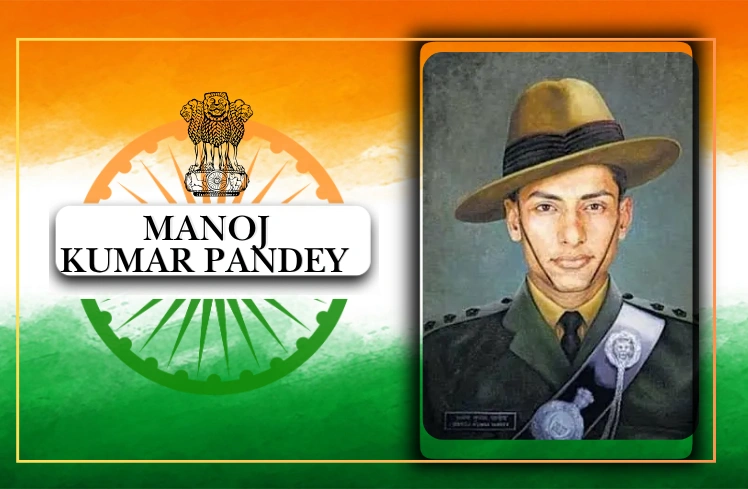
Captain Manoj Kumar Pandey did win the Param Vir Chakra — India’s highest military honour. Tragically, he received it posthumously. He was just 24 years old when he made the ultimate sacrifice on the frozen heights of Khalubar during the 1999 Kargil War. But in those 24 years, he lived more than most of us could dream of in 80.
Disclaimer: This article is written purely for informational and educational purposes. All facts mentioned have been verified through credible sources including Wikipedia, official military records, Honourpoint.in, and other reputable platforms. The author holds deep respect for all armed forces personnel and their families. This is not affiliated with or endorsed by the Indian Army or any government body.
Quick Stats: Captain Manoj Kumar Pandey at a Glance
| Detail | Information |
|---|---|
| Full Name | Captain Manoj Kumar Pandey |
| Date of Birth | 25 June 1975 |
| Place of Birth | Rudha Village, Sitapur District, Uttar Pradesh |
| Date of Martyrdom | 3 July 1999 |
| Age at Martyrdom | 24 Years |
| Regiment | 1st Battalion, 11th Gorkha Rifles (1/11 GR) |
| Service Number | IC-56959W |
| Awards | Param Vir Chakra (Posthumous) |
| PVC Serial Number | 21st Recipient |
| Battle(s) | Operation Vijay — Battle of Khalubar, Batalik Sector, Kargil |
| Famous Last Words | “Na chhodnu” (Don’t spare them — in Nepali) |
| Portrayed By | Ajay Devgn in LOC: Kargil (2003) |
| Father | Shri Gopi Chand Pandey |
| Mother | Smt. Mohini Pandey |
From a Small Village to the Nation’s Biggest Stage
Manoj Kumar Pandey wasn’t born with a silver spoon. He was born in Rudha village in the Sitapur district of Uttar Pradesh on 25 June 1975. His father, Shri Gopi Chand Pandey, ran a small business in Lucknow. Not wealthy. Not connected. Just a middle-class family with big values and an even bigger son.
What set young Manoj apart from the start was not the family’s resources — it was his fire.
He studied at the Uttar Pradesh Sainik School in Lucknow (yes, that kind of school — the kind that shapes soldiers), and later completed his senior secondary from Rani Laxmi Bai Memorial Senior Secondary School. He was a natural at sports, particularly boxing and bodybuilding. The kid punched things for fun. (Turns out that came in handy.)
Here’s a little detail that’ll make you emotional: Manoj’s father couldn’t afford his school fees. But Manoj was so academically sharp and athletically gifted that he funded his entire education through scholarships and awards. The boy literally earned his own way into the army.
The SSB Interview That Became Legend
If there’s one story that defines the spirit of Captain Manoj Kumar Pandey, it’s this one.
At his Services Selection Board (SSB) interview — the gruelling evaluation process that every aspiring army officer must clear — the interviewer asked him the standard question: “Why do you want to join the Indian Army?”
Most candidates rehearse diplomatic, textbook answers. Not Manoj.
He said, straight-faced and completely serious: “I want to win the Param Vir Chakra.”
The interviewer must have blinked. The room must have gone quiet. And then — Manoj cleared the interview.
He went on to graduate from the National Defence Academy (NDA) in the 90th course, staying in the MIKE Squadron. He was commissioned into the 1/11 Gorkha Rifles — a regiment he had specifically asked for. This is a regiment with a fierce reputation and a battle cry that sends shivers down spines: “Jai Mahakali, Aayo Gorkhali!”
And years later, that SSB interviewer got to witness the most extraordinary “told you so” in Indian military history.
The Poet-Soldier: Manoj’s Diary
Here’s the part of the Captain Manoj Kumar Pandey story that most people don’t know — and it’s arguably the most beautiful.
Manoj was an introvert. Between the boxing, the bodybuilding, and the army training, he quietly carried a personal diary and wrote his thoughts and feelings in it. And what he wrote? Absolutely spine-tingling.
One of his most famous diary entries reads:
“If death strikes before I prove my blood, I promise, I will kill death.”
Another line from his diary that has been quoted in countless tributes across India:
“Some goals are so worthy, it’s glorious even to fail.”
Read that again. Let it sink in.
This wasn’t a warrior’s bravado. This was a philosopher in uniform — a young man who had made peace with the highest stakes imaginable and still chose to run toward the danger.
He was writing poetry while preparing for war. He was penning his soul while sharpening his bayonet. Manoj Kumar Pandey was not just a soldier — he was a human being of rare depth and courage.
Operation Vijay: The Hero of Batalik
The year was 1999. Pakistani forces had stealthily occupied Indian positions in the Kargil sector during winter, and India launched Operation Vijay to reclaim its land.
Captain Manoj Kumar Pandey was part of the 1/11 Gorkha Rifles, one of the first units inducted into the critical Batalik sector theatre. His commanding officer was Colonel Lalit Rai, and Manoj was given some of the most dangerous tasks of the operation.
He didn’t flinch. Not once.
His unit captured the strategically vital Jubar Top — a mission considered so difficult that earlier patrol parties from other units had gone missing entirely. Where others had hesitated, Manoj Kumar Pandey led from the front, forcing intruders back with heavy losses.
This performance earned him the informal but fiercely earned title: “Hero of Batalik.”
But even that wasn’t his finest hour. That came on a freezing night in July 1999.
The Night of 2/3 July 1999: India’s Most Heroic Last Stand
On the night of 2/3 July 1999, Captain Manoj Kumar Pandey was the Number 5 Platoon Commander tasked with an advance toward Khalubar — a critical ridgeline at an elevation of approximately 16,700 feet above sea level. This was not a Sunday morning walk.
As his platoon approached their final objective, they came under heavy, intense enemy fire from the surrounding heights. The battalion was in a dangerously exposed position and risked being caught in daylight — a military nightmare at those altitudes.
Manoj acted immediately.
He quickly repositioned his platoon under direct fire — no cover, no safety, just pure calculated movement — sent one section to clear enemy positions from the right, and led the assault from the left himself.
What happened next is the stuff of legend.
- He assaulted the first enemy bunker fearlessly. Two enemy soldiers killed.
- He destroyed the second bunker. Two more eliminated.
- He was wounded in the shoulder and legs clearing the third position.
A lesser man — or honestly, any reasonable human being — would have called for retreat at this point.
Manoj didn’t.
Bleeding and injured, he charged the fourth bunker, destroyed it with a grenade, and was struck by a fatal burst of fire to the forehead.
His last words — shouted in Nepali to his men — were: “Na chhodnu.”
Don’t spare them.
He succumbed to his injuries soon after. But the Khalubar had been secured. The battalion had its critical firm base. The companies could advance. Captain Manoj Kumar Pandey’s sacrifice had changed the course of the battle.
In that single night, his platoon killed 11 enemy soldiers, captured 6 bunkers, and seized an air defence gun along with other ammunition.
The Param Vir Chakra: A Promise Kept
Captain Manoj Kumar Pandey became the 21st recipient of the Param Vir Chakra — India’s highest military honour, awarded for the most conspicuous bravery in the face of the enemy.
The official PVC citation reads — and we’re paraphrasing because these words deserve your full emotional attention:
“Most conspicuous bravery, indomitable courage, exemplary personal valour, outstanding leadership and devotion to duty of an exceptionally high order.”
His father, Shri Gopi Chand Pandey, received the award from the President of India on the 52nd Republic Day. Imagine that moment — a father accepting his son’s highest honour, knowing what it cost.
Manoj is also the first Lieutenant to have been awarded the Param Vir Chakra in the entire Indian Army. He was posthumously promoted to Captain.
The boy who told his SSB interviewer he’d win the Param Vir Chakra — won the Param Vir Chakra.
The Legacy That Lives On
Captain Manoj Kumar Pandey may have been with us for only 24 years, but his name has been etched into institutions, buildings, and hearts across India.
Here’s what has been done to honour his memory:
- Manoj Vihar — The Army Welfare Housing Organisation (AWHO) constructed and named an apartment complex for veterans in Ghaziabad, Uttar Pradesh after him.
- Kargil War Museum, Dras — A dedicated gallery bears his name.
- Rani Laxmi Bai Memorial School, Lucknow — His alma mater built an auditorium in his name, inaugurated by his parents.
- Army Quarters, Pune — Named after him near the Cardio Thoracic Centre hospital.
- Annual Football Tournament — The ‘Late Capt. Manoj Kumar Pandey PVC Football Tournament Trophy’ is held annually at UP Sainik School as an inter-school competition.
- Amar Chitra Katha (2015) — His story was featured in the Param Vir Chakra comic series.
- Roli Books (2019) — A graphic novel titled Param Vir Chakra: Manoj Kumar Pandey was published by Ian Cardozo.
- LOC: Kargil (2003) — J.P. Dutta’s war film featured Manoj’s story, with Ajay Devgn playing the role of Captain Manoj Kumar Pandey.
Every 26 July (Kargil Vijay Diwas) and every 3 July (his martyrdom anniversary), memorial ceremonies are held in his honour. The nation remembers, even if it doesn’t always say so loudly enough.
Why Captain Manoj Kumar Pandey Still Matters Today
We live in a time of social media virality, overnight fame, and 15-second attention spans. So let’s ask honestly — why should a 24-year-old army officer from 1999 still matter to us?
Because Manoj Kumar Pandey teaches us something that no influencer, no motivational speaker, and no LinkedIn post can:
Conviction + Action = Legacy.
He didn’t just dream of winning the Param Vir Chakra. He trained for it. He studied for it. He earned scholarships for it. He chose the regiment best suited for it. He led men into impossible situations because of it. And when the moment came — wounded, bleeding, at nearly 17,000 feet above sea level — he still didn’t stop.
He literally killed death. Just like he wrote in his diary.
For students preparing for the NDA or SSB, for young officers in training, for anyone wondering whether bold dreams are worth chasing — Captain Manoj Kumar Pandey is your answer.
Conclusion: Some Goals Are So Worthy…
If you’ve read this far, you already know the answer.
Captain Manoj Kumar Pandey was not a fictional superhero. He was a boy from Sitapur who loved boxing, wrote poetry in his diary, told an SSB interviewer an answer no one expected, and then — quietly, methodically, and with absolute conviction — made every single word of it come true.
He climbed a ridge at 16,700 feet. He cleared four enemy bunkers while injured. He said “don’t spare them” as his final words. And he handed his country a victory it would have struggled to achieve without him.
He was 24.
The next time life feels difficult, or a dream feels too big, or someone tells you that you’re being unrealistic — remember the line from his diary:
“Some goals are so worthy, it’s glorious even to fail.”
Captain Manoj Kumar Pandey didn’t fail. And neither will you.
Jai Hind. 🇮🇳
Read more:
Frequently Asked Questions
Q1. Who was Captain Manoj Kumar Pandey?
Captain Manoj Kumar Pandey was an Indian Army officer of the 1/11 Gorkha Rifles who was posthumously awarded the Param Vir Chakra — India’s highest military decoration — for his extraordinary bravery during the 1999 Kargil War.
Q2. When and where was Manoj Kumar Pandey born?
He was born on 25 June 1975 in Rudha village, Sitapur district, Uttar Pradesh.
Q3. How did Captain Manoj Kumar Pandey die?
He was fatally wounded during the assault on enemy bunkers at Khalubar Hills in the Batalik Sector on the night of 2/3 July 1999. He was struck by a bullet to the forehead while leading a charge on the fourth enemy bunker, even after being injured in the shoulder and legs.
Q4. What is the Param Vir Chakra?
The Param Vir Chakra is India’s highest military honour, awarded for the most conspicuous acts of bravery in the face of the enemy. Captain Manoj Kumar Pandey was its 21st recipient.
Q5. Who played Captain Manoj Kumar Pandey in the movies?
Ajay Devgn portrayed Captain Manoj Kumar Pandey in the 2003 war film LOC: Kargil directed by J.P. Dutta.
Q6. What were Captain Manoj Kumar Pandey’s last words?
His last words were “Na chhodnu” — a Nepali phrase meaning “Don’t spare them” — shouted to his men as he led the final charge.
Q7. What did Captain Manoj Kumar Pandey write in his diary?
Two of his most famous diary lines are: “If death strikes before I prove my blood, I promise, I will kill death” and “Some goals are so worthy, it’s glorious even to fail.”
Q8. What was Captain Manoj Kumar Pandey’s regiment?
He served in the 1st Battalion, 11th Gorkha Rifles (1/11 GR) of the Indian Army.
Q9. How old was Captain Manoj Kumar Pandey when he died?
He was just 24 years old at the time of his martyrdom.
Q10. Is there anything named after Captain Manoj Kumar Pandey?
Yes — Manoj Vihar (veteran housing complex in Ghaziabad), a gallery at the Kargil War Museum in Dras, an auditorium at his school in Lucknow, army quarters in Pune, and an annual football tournament at UP Sainik School are all named in his honour.
For more verified information, you can refer to this trusted external source: Officerprofile