


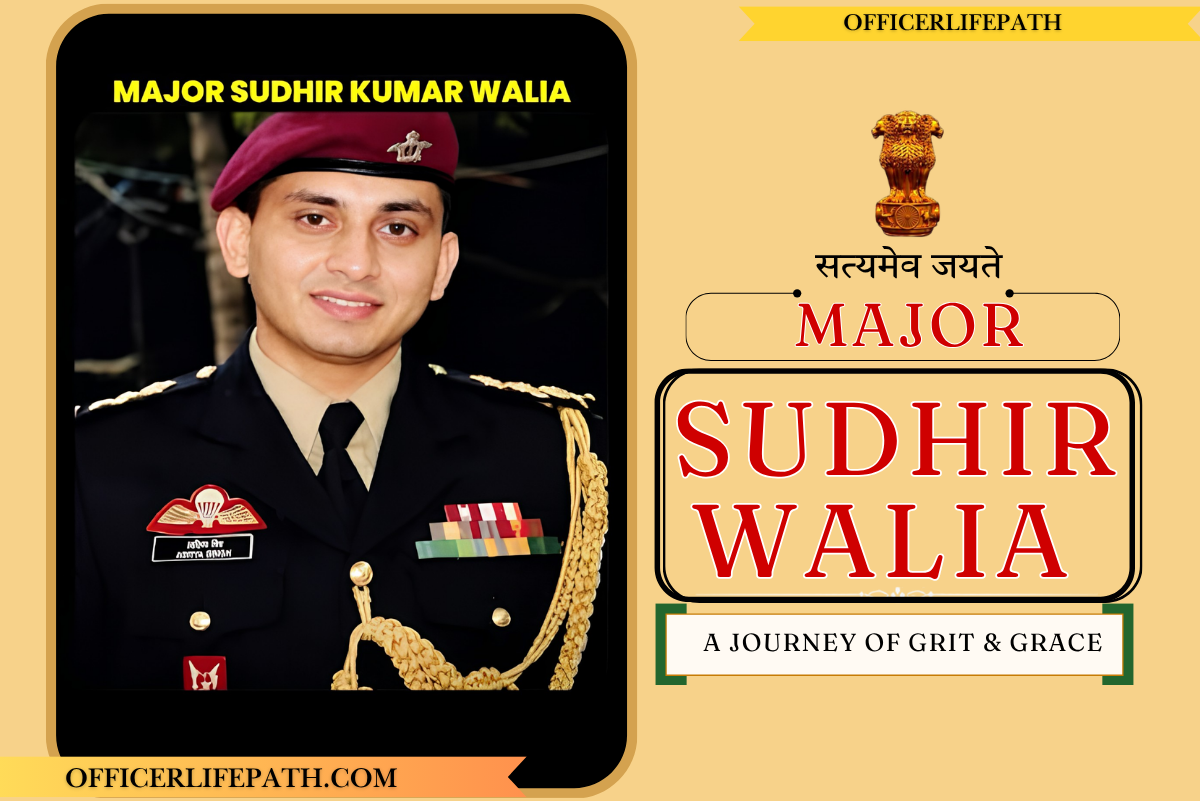
Major Sudhir Walia was a 9 Para (Special Forces) officer of the Indian Army who received the Ashoka Chakra — India’s highest peacetime gallantry award — posthumously in 2000. He is known as the “Rambo of the Indian Army” for his extraordinary bravery.
Quick Stats: Major Sudhir Walia at a Glance
| Parameter | Details |
|---|---|
| Full Name | Major Sudhir Kumar Walia |
| Born | 24 May 1968 |
| Major Sudhir Walia Birthday | 24 May 1968, Military Hospital, Jodhpur, Rajasthan |
| Home Village | Banuri, Kangra District, Himachal Pradesh |
| Major Sudhir Walia Father | Subedar Major Rulia Ram Walia (Army Veteran) |
| Mother | Smt. Rajeshwari Devi |
| Siblings | Brother: Arun Walia (b. 2 Oct 1972); Sister: Bindiya Walia (b. 22 Feb 1976) |
| Major Sudhir Walia Wife | No publicly confirmed spouse; unmarried at time of martyrdom |
| Major Sudhir Walia Height | Approximately 5’10” (based on Para SF physical standards; not officially published) |
| Major Sudhir Walia Caste | Jat (commissioned into 4th Battalion, The Jat Regiment) |
| Education | Sainik School Sujanpur Tira → NDA Khadakwasla (1984) → IMA Dehradun |
| Commissioned | 11 June 1988 — 4th Battalion, The Jat Regiment |
| SF Unit | 9 Para (Special Forces), Indian Army |
| Nickname | “Rambo of the Indian Army” |
| Awards | Ashoka Chakra (posthumous), Sena Medal, Bar to Sena Medal |
| Date of Martyrdom | 29 August 1999, Haphruda Forest, Kupwara, J&K |
| Age at Martyrdom | 31 years |
| Pentagon Connection | Topped international military course in 1997; standing ovation from officers of 80 nations |
| Kargil Achievement | Captured Zulu Top (5,200 m) in Mushkoh Valley; hoisted Tricolour on 25 July 1999 |
| Major Sudhir Walia Book | Rambo by Col. Ashutosh Kale; Coomar by Jaishree Laxmikant |
Who Was Major Sudhir Walia?
- Major Sudhir Walia was a decorated Indian Army officer and 9 Para Special Forces commando from Himachal Pradesh.
- Born into a military family, he dedicated his career to serving the nation and became a Kargil War hero.
- He played a key role in capturing a strategic 17,000-foot peak during the Kargil conflict.
- He was reportedly the only Indian officer to receive a standing ovation at the Pentagon from defence officials representing 80 countries.
- Major Walia was 31 years old when he was killed in action in 1999.
- Even after being critically wounded, he continued directing his men until his final moments.
Major Sudhir Walia Family Background: Where It All Started
Every great soldier has an origin story. For Major Sudhir Walia, that story begins in Banuri village, Kangra District, Himachal Pradesh.
Major Sudhir Walia Father: The First Uniform in the Family
- Major Sudhir Walia’s father, Subedar Major Rulia Ram Walia, was a retired Indian Army veteran
- Military service wasn’t a career option in the Walia household — it was DNA
- Young Sudhir grew up listening to stories of discipline, mountains, duty, and sacrifice
- Major Sudhir Walia was the first boy from his village — Banuri — to become a commissioned Indian Army officer
Major Sudhir Walia Family Members
| Family Member | Name | Detail |
|---|---|---|
| Father | Subedar Major Rulia Ram Walia | Retired Army veteran; received Ashoka Chakra on son’s behalf |
| Mother | Smt. Rajeshwari Devi | Present at all memorial and book launch events |
| Brother | Arun Walia | Born 2 October 1972 |
| Sister | Bindiya Walia | Born 22 February 1976 |
Major Sudhir Walia Wife
- Public records and published books do not confirm a spouse
- Major Sudhir Walia was 31 years old at the time of his martyrdom and had spent his entire adult life in elite military postings
- His two books (Rambo and Coomar) do not reference a wife
- Out of respect for the Major Sudhir Walia family, we will not speculate
Schooling, NDA, and the Making of a Commando
Education Timeline
| Year | Institution | Milestone |
|---|---|---|
| Early years | Government School, Banuri | Primary education in home village |
| ~1982 | Sainik School Sujanpur Tira, HP | One of India’s premier feeder schools for defence |
| 1984 | National Defence Academy (NDA), Khadakwasla | Cleared one of India’s most competitive exams |
| 1987 | Passed out of NDA | Ready for officer training |
| 1988 | Indian Military Academy (IMA), Dehradun | Commissioned as Second Lieutenant |
| 11 June 1988 | 4th Battalion, The Jat Regiment | First posting as commissioned officer |
From Sri Lanka to Siachen: Major Sudhir Walia’s Military Career
IPKF: Early Military Service
- Major Sudhir Walia served in Sri Lanka with the Indian Peace Keeping Force (IPKF).
- He was part of the 4th Battalion, The Jat Regiment.
- The deployment gave him experience in counter-insurgency operations and challenging terrain.
Para SF: Joining 9 Para
- Major Sudhir Walia volunteered for 9 Para Special Forces.
- He cleared the selection process and joined the elite unit.
- His service included operations in demanding environments.
Siachen: Two Postings
- Major Sudhir Walia completed two separate six-month postings at the Siachen Glacier.
- He served in extreme cold and high-altitude conditions.
Sena Medal and Bar
- He received the Sena Medal in 1994 for operations in Jammu & Kashmir.
- He later received a Bar to the Sena Medal for subsequent gallantry.
Pentagon Major Sudhir Walia: The International Recognition
The 1997 Military Course
- In 1997, Captain Sudhir Walia attended a specialised international military course in the United States.
- Officers from around 80 countries participated.
- He reportedly topped the course, impressing fellow officers who informally called him “Colonel” despite his rank of Captain.
The Pentagon Speech
- After completing the course, Major Sudhir Walia was reportedly invited to address the gathering at the Pentagon.
- He spoke before officers representing around 80 nations.
- His address reportedly received about five minutes of applause and a standing ovation.
Pentagon Moment — Quick Summary
| Detail | Fact |
|---|---|
| Year | 1997 |
| Countries Present | 80 |
| Sudhir’s Rank at the Time | Captain |
| Course Result | Topped the course |
| Nickname Given by Peers | “Colonel” |
| Standing Ovation Duration | ~5 minutes |
ADC to the Army Chief: When Comfort Wasn’t Enough
After the Pentagon, Major Sudhir Walia was posted as Aide-de-Camp (ADC) to General VP Malik — the Chief of Army Staff.
- Performed his ADC duties with the same sharp excellence he brought to everything
- When the Kargil War broke out in May 1999, he wrote a formal application to General Malik requesting permission to go to the front
- General Malik granted it — recognising exactly what kind of officer was standing before him
Timeline:
| Period | What He Was Doing |
|---|---|
| Post-1997 | ADC to Army Chief, New Delhi |
| May 1999 | Kargil War breaks out |
| June 1999 | Submits formal application to join his unit at front |
| Within 10 days | Deployed to Mushkoh Valley with 9 Para SF |
| 25 July 1999 | Captures Zulu Top |
Kargil 1999: Zulu Top and the 17,000-Foot Mission
The Kargil War (May–July 1999) was India’s most intense conventional conflict since 1971. Pakistani forces had infiltrated strategic peaks in the Kargil sector. India’s response involved some of the most brutal high-altitude warfare in military history.
Zulu Top: The Mission
- Major Sudhir Walia led an assault team from 9 Para (SF) to attack and capture Zulu Top
- Location: Mushkoh Valley, Kargil sector
- Altitude: 5,200 metres (approximately 17,000 feet)
- Date of capture: 25 July 1999 — one day before Vijay Diwas (26 July 1999)
Kargil Achievement Summary
| Detail | Fact |
|---|---|
| Operation | Capture of Zulu Top |
| Peak Altitude | 5,200 metres / ~17,000 feet |
| Location | Mushkoh Valley, Kargil |
| Date | 25 July 1999 |
| Flag Hoisted | Indian Tricolour |
| Context | One day before Vijay Diwas |
How Major Sudhir Walia Died: The Last 35 Minutes
This is the section that changes people.
The Setup: 29 August 1999
The Kargil War had officially ended. Major Sudhir Walia chose to remain in Kashmir for ongoing counter-insurgency operations. Because of course he did.
The Mission: Haphruda Forest, Kupwara
- Time: Approximately 08:30 AM
- Mission type: Search and Destroy
- Squad: Major Sudhir Walia + 5 commandos
- Target area: Dense undergrowth, Haphruda Forest, Kupwara District, J&K
What Happened — Minute by Minute
| Time | Event |
|---|---|
| ~08:30 AM | Squad enters Haphruda Forest on S&D mission |
| Shortly after entry | Squad stumbles upon a well-camouflaged terrorist hideout with ~20 heavily armed militants |
| Immediate | Major Sudhir Walia surges ahead — neutralises sentries, kills multiple militants single-handedly (6–9 per various accounts) |
| Mid-operation | Shot in the face, arm, and chest — grievous, life-threatening wounds |
| Despite wounds | Refuses evacuation; picks up radio set |
| Next 35 minutes | Commands the entire operation from the ground — coordinates blocking of escape routes, directs his team, ensures zero escape |
| Operation complete | Every terrorist neutralised |
| Post-operation | Only then allows evacuation |
| En route to hospital | Succumbs to injuries while being airlifted |
| Final image | Found still clutching his radio set |
Awards & Decorations: A Career’s Worth in 11 Years
| Award | Year | Reason |
|---|---|---|
| Sena Medal | 1994 | Counter-insurgency ops, J&K |
| Bar to Sena Medal | Post-1994 | Further gallantry in J&K |
| Ashoka Chakra | 26 Jan 2000 (posthumous) | Haphruda Forest operation, Kupwara |
The Ashoka Chakra Moment
- Presented by President K. R. Narayanan on Republic Day, 26 January 2000
- Received by Major Sudhir Walia’s father — Subedar Major (Retd.) Rulia Ram Walia
- A retired soldier father, accepting India’s highest peacetime honour on behalf of his martyred son
Major Sudhir Walia Book: Two Tributes That Tell His Full Story
| Book | Author | Released By | Platform |
|---|---|---|---|
| Rambo | Col. Ashutosh Kale | Former Army Chief General VP Malik | |
| Coomar: The Story of Major Sudhir Walia, AC, SM | Jaishree Laxmikant | — | |
| Yoddha (audio episode) | Neelesh Misra | — | Digital/Podcast |
- Rambo was released in the presence of the Major Sudhir Walia family
- Yoddha by Neelesh Misra brought Sudhir’s story to millions of listeners across India post-2018
Legacy: Schools, Statues, and a Fight the Family Had to Win
Memorials & Honours
| Memorial | Location | Status |
|---|---|---|
| Senior Secondary School | Kangra District, HP | Named after Major Sudhir Walia |
| Memorial | Palampur, HP | Established |
| Memorial | Banuri Village, HP | Established |
| Statue | Palampur, HP | Secured after family campaign |
The Statue Controversy (A Battle Off the Battlefield)
- The Major Sudhir Walia family had to fight the Himachal Pradesh state government for years to get a statue installed in Palampur
- The delay became so frustrating the family announced they would return the Ashoka Chakra in protest
- Multiple ex-Army officers and civilian organisations rallied behind the family
- The state government eventually accepted the demand
- The statue was subsequently installed
- (Citation needed: Exact year of installation — suggested source: HP government press releases or family statement to media)
Conclusion
- Major Sudhir Walia was born on 24 May 1968 in Jodhpur, with family roots in Kangra, Himachal Pradesh.
- He served in challenging theatres including Sri Lanka, Siachen, Kargil, and Kupwara.
- As Pentagon Major Sudhir Walia, he reportedly topped an international military course attended by officers from 80 countries and received a standing ovation.
- During the Kargil War, he captured Zulu Top at 5,200 metres on 25 July 1999.
- He was killed in action on 29 August 1999 in Haphruda Forest at the age of 31, continuing to command his men despite severe injuries.
- He was posthumously awarded the Ashoka Chakra on 26 January 2000.
- His story has been featured in books including Rambo and Coomar, as well as Neelesh Misra’s Yoddha audio series.
- His family campaigned for a statue in Palampur to honor his legacy.
Read more:
Frequently Asked Questions
Q1. Who was Major Sudhir Walia?
A 9 Para Special Forces officer and Kargil War hero, posthumously awarded the Ashoka Chakra.
Q2. What is the Pentagon connection?
He reportedly topped a 1997 international military course attended by officers from 80 countries and received a standing ovation at the Pentagon.
Q3. How did Major Sudhir Walia die?
aphruda Forest, Kupwara, while leading his men.
Q4. What books cover his life?
Rambo, Coomar: The Story of Major Sudhir Walia, AC, SM, and the Yoddha audio series.
Q5. When was he born?
24 May 1968, in Jodhpur, Rajasthan.
Q6. What was Zulu Top?
A 5,200-metre strategic peak captured by 9 Para SF during the Kargil War.
Q7. Who received his Ashoka Chakra?
His father, Subedar Major (Retd.) Rulia Ram Walia, received it in 2000.
For more verified information, you can refer to this trusted external source: Officerprofile
- Quick Stats: Major Sudhir Walia at a Glance
- Who Was Major Sudhir Walia?
- Major Sudhir Walia Family Background: Where It All Started
- Major Sudhir Walia Father: The First Uniform in the Family
- Major Sudhir Walia Family Members
- Major Sudhir Walia Wife
- Schooling, NDA, and the Making of a Commando
- From Sri Lanka to Siachen: Major Sudhir Walia’s Military Career
- Pentagon Major Sudhir Walia: The International Recognition
- ADC to the Army Chief: When Comfort Wasn’t Enough
- Kargil 1999: Zulu Top and the 17,000-Foot Mission
- How Major Sudhir Walia Died: The Last 35 Minutes
- Awards & Decorations: A Career’s Worth in 11 Years
- Major Sudhir Walia Book: Two Tributes That Tell His Full Story
- Legacy: Schools, Statues, and a Fight the Family Had to Win
- Conclusion
- Frequently Asked Questions